Every effect below is computed from the physics rather than approximated by a
shader trick, and every one is pinned by a host test against its closed-form answer.
recursive mirrors
Facing mirrors produce a true infinite corridor, to any depth, at any viewing angle.
Screen-space reflection structurally cannot draw this frame: it can only reflect what
is already on screen. Here the rays really bounce, up to sixteen times.
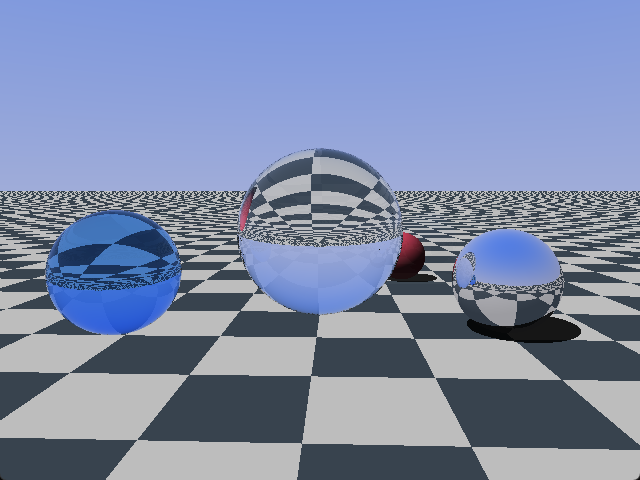
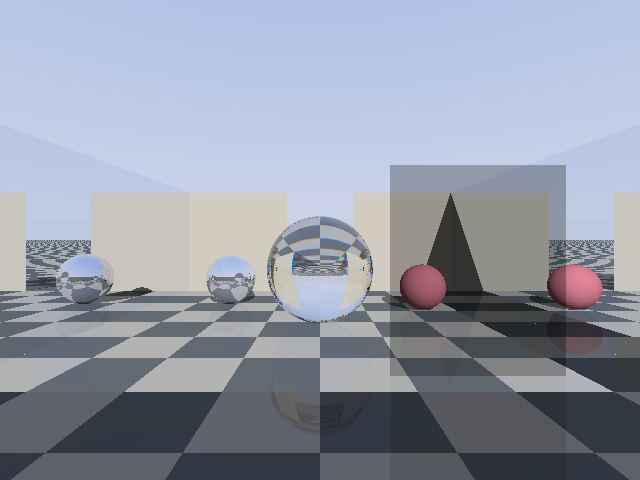
glass by the Fresnel equations
The real pair, s and p computed separately, not Schlick's fit. Refraction, total
internal reflection, and reflectance that climbs toward grazing incidence because
physics says so and not because a parameter does. The checker floor hanging upside
down inside the ball lens is the classic proof that the refraction is real.
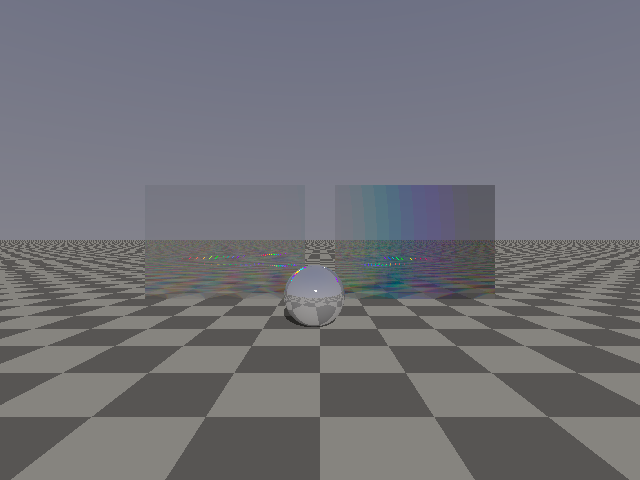
spectral light
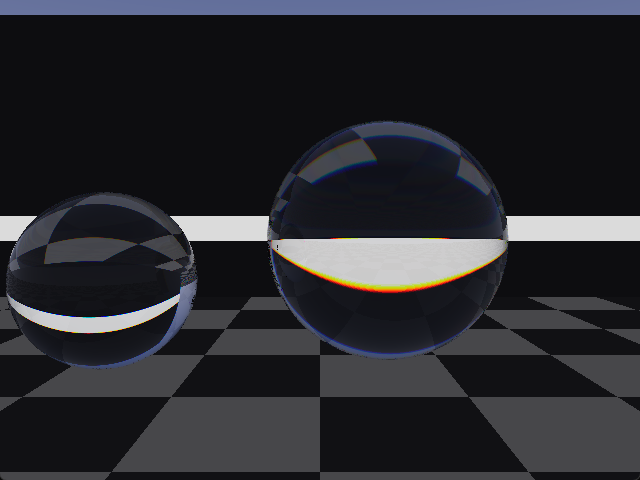
Twelve wavelengths per pixel, each refracting at its own Cauchy n(lambda), folded to
sRGB through the CIE 1931 color matching functions. Crown glass fringes gently. Flint
tears the same white edge into a spectrum about five times wider, which is exactly why
camera lenses pair the two.
polarization
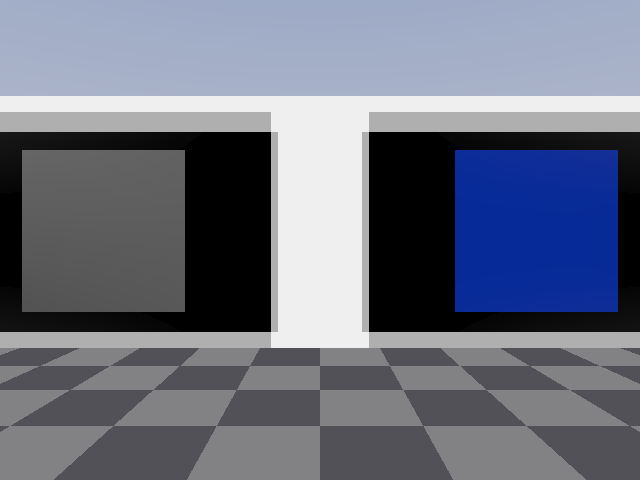
Every ray carries a Stokes vector and every interface applies a Mueller matrix.
Crossed polarizers go black. A third pane at 45 degrees between them brings back
exactly one eighth. A waveplate writes interference color because its retardance
runs as 1/lambda.
curved mirrors, specified like real optics
A mirror is written down the way an optical designer would write it: apex, axis,
radius of curvature at the vertex, conic constant, and the rim that bounds it. Aim a
paraboloid at the sun and stand at its focus, and every part of the dish shows you
the sun at once, so the whole mirror goes white. It is a solar furnace, seen from
where the heat would be.
diffraction gratings
The conical, off-plane vector form. The groove component of the direction is
conserved, the dispersion component picks up m·lambda/d, and m = 0 falls out as
exact specular. Orders sweep across a ruled panel as you walk, the way a CD tilts its
colors.
the oracle
source/cpu_trace.c is a complete second tracer in plain C, and the three shaders
under shaders/ are its statement-for-statement twins. The C version is allowed
to be slow and obliged to be right: every optical law lands there first, held by host tests
to closed-form answers. Then holo_oracle_diff() reads the presented GPU frame
back and compares it to a CPU render of the same camera.
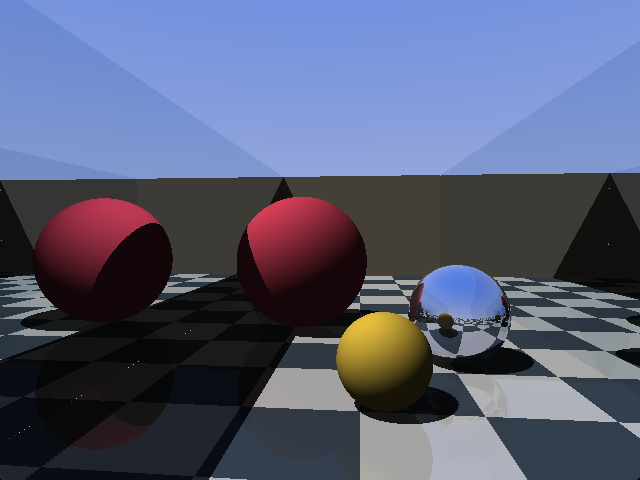
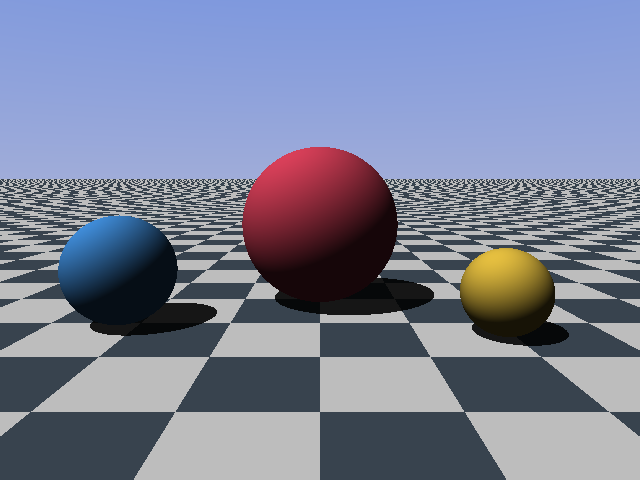
The oracle's first picture, rendered by the plain C tracer.
That diff is the engine's central correctness mechanism. A change that lands in one tracer
and not the others stops being a mystery and becomes a failing exit code. The bar is a mean
error under 1/255 with fewer than 0.75% of pixels off by more than 8/255, and all eight
examples pass on every proven path: the HLSL tracer runs 0.019 to 0.118 mean under D3D11, the
GLSL one 0.027 to 0.251 under WebGL2 and 0.0001 to 0.080 natively on Linux, where Mesa's
software rasteriser does the arithmetic the way the C oracle does and the agreement tightens
to four decimal places. The outlier percentages track each other almost exactly, which is the
number worth reading, since it says every tracer takes the same branches and culls the same
rays.
The host tests assert physics rather than pixels: 382 checks across 8 suites covering
Snell's angles into n=1.5 glass, the 41.81 degree critical angle, 4% reflectance at normal
incidence, a vanishing p-component at Brewster's angle, Malus's law at five angles, the
three-polarizer paradox to the exact eighth, BK7's Abbe number computing to its catalog 64,
a paraboloid focusing every zone at R/2, an ellipsoid imaging focus onto focus, Littrow
retroreflection, and the conical invariant.
modules
linalgVectors, and the optics that is vector arithmetic: reflection, Snell refraction, Fresnel, the grating equation
polarStokes rows, Mueller matrices, Fresnel amplitudes with the TIR phase
spectrumWavelength samples, Cauchy dispersion, CIE color matching
geometryRays against spheres, planes, rectangles and conic dishes
cameraThe camera as a ray generator
cpu_traceThe reference tracer, the oracle
gpu_sceneThe scene as the shader's uniform block
collisionCapsule-vs-walls walking with gravity
timestepFixed-step accumulator, ported from magnolia
displayThe only file that talks to sokol: window, device, quad, uniforms, frame readback
inputKeys held and mouse look, folded per frame
oracleThe GPU-vs-CPU frame diff, and the dump that holds an out-of-process tracer to it
the examples
Each milestone left a runnable demo behind.
ExampleWhat it shows
m0_windowA window, a fullscreen quad, uniforms arriving every frame.
m1_cpuThe CPU tracer's first picture, written to a PPM.
m2_gpuThe same scene traced on the GPU, held to the oracle.
m3_mirrorsFacing mirror walls, a chrome sphere, a polished floor, all recursing.
m4_glassA ball lens holding the checker floor upside down inside it.
m5_spectralCrown and flint glass in front of one white stripe.
m6_polarizationThe three-polarizer paradox, and a waveplate's interference color.
m7_roomThe vertical slice: a room of mirrors, glass, a polarizer and a flint ball that you walk through in first person.
m8_furnaceA paraboloid with its focus at eye height on the path. Walk into it.
m9_spectrumTwo ruled gratings throwing the sun's orders back at you.
m7_room, the vertical slice. Crystal Mirror Maze is now being built on this frame.
m7_room, m8_furnace and m9_spectrum are interactive:
click to capture the mouse, WASD to walk, Space to jump,
T to toggle spectral tracing, Escape to release the mouse.
Every GPU example also accepts --diff, which renders the same frame through the
CPU tracer and compares. The exit code is the verdict.
about
An optics-first 3D game engine by magmacrunch media.
The games it exists for, starting with Crystal Mirror Maze, are built entirely from analytic
primitives (planes, rectangles, spheres, conics) and rendered at low resolution by design.
Closed-form intersections at 640x480 are exactly the workload a fullscreen-shader ray tracer
can afford in real time, and a tracer is the only renderer in which curved mirrors,
refraction, dispersion and polarization come out correct rather than faked.
C99 engine and one tracer in three dialects, HLSL for D3D11, GLSL for GL and GLES3/WebGL2, MSL
for Metal, on sokol
for the window, GPU device and swapchain. Windows ships and Linux is proven: all eight examples
pass the oracle natively on GL as well as under D3D11, and the unmodified Windows binary also
passes under Wine given Microsoft's d3dcompiler_47.dll beside it. The Metal
dialect is written and type-checked, and has not yet met a Metal device. The tracing runs on
the GPU as a fullscreen-quad fragment shader over a scene of analytic primitives delivered in one
uniform block, on a fixed-timestep simulation ported from magnolia.
Games compile the engine's sources directly, magnolia-style: there's no library build and no
package registry, and a game is three callbacks and a scene.
building
Requires Visual Studio on Windows, or any C compiler on Linux. No other
dependencies, since sokol is vendored.
build.bat          # Windows: every example into build\
build.bat test     # builds and runs the host tests
./build.sh test    # the same, on Linux or macOS
Run the examples from the source root. They read shaders\trace.hlsl at
startup, so you can edit the tracer and relaunch without recompiling.
A scene is C: every room is a set of analytic surfaces written as struct literals, and the
engine never loads a scene file or draws a triangle. A browser editor runs the same tracer
live, lets you move things around, and writes the room back out as C. Movement is a capsule
walking against axis-aligned walls, which is all a mirror maze asks of physics. The games it
is built for need nothing more, so it carries none of the general machinery a bigger engine
would.
the name
Named after the Dag Henderson track "hologram of a dream", published by magmacrunch music.
PolyForm Noncommercial 1.0.0 · Copyright 2026 magmacrunch media.
Any noncommercial purpose is permitted, and commercial use is reserved to magmacrunch media.
magmacrunch's 2D engines were Apache-2.0 infrastructure for anyone until 2026-10-15, when they
moved to this license too, so hologram is no longer the exception it was. Vendored sokol
headers, by Andre Weissflog, keep their zlib license.
// source access //
hologram is developed in-house and is not publicly distributed.
The modules reference covers the public C API, and the gallery
above shows what the tracer renders.